Punching Bag
✽ Introduce yourself, where you're from, and what you do.
My name is Rob Ayling. I'm a writer and director in film and theatre. I was born in Cwmbran, in Wales. My mother is from India and my dad was from London, and I currently am based in North London, and I'm a freelance filmmaker.
✽ Tell us a little bit about the short film Punching Bag.
Punching Bag is a short film drama about an amateur boxer who is battling his demons as well as his opponent in what could prove to be the fight of his life, so the film tackles mental health issues, loneliness, addictions, and not to give too much away, but this idea of hope and redemption whilst battling a physical as well as a inner opponent, which is yourself.
✽ Did you pull much from your own experience?
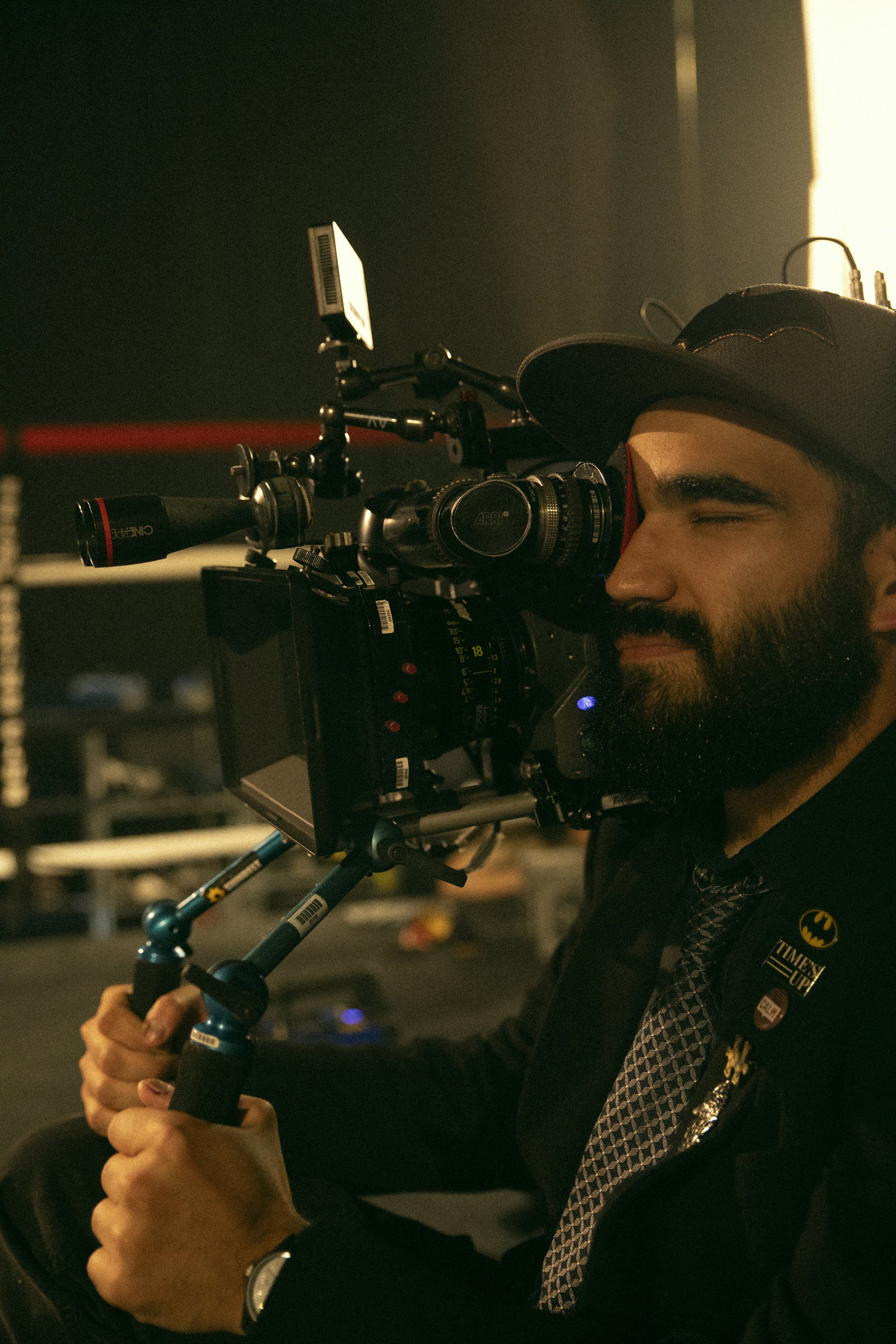
There is an old expression, which is you write what you know, and this is very much the case in point with Punching Bag. I took directly from my own experiences, especially in regards to the addiction side of the film, as well as the deeper mental health aspect of the film. It's very much a combination of my story and Michael Ajhi story, who plays the lead Elijah in the film. As you can tell, I'm clearly the boxer, from my attire. You can see alone. (Rob was dressed in a suit with a crisp Batman baseball cap on). But having said that, I did learn how to box in the process of making this film. In the process of that, it helped me battle my own struggles with mental health in another way, whereas usually I would just be actively staying creative, that for me is a form of healing. Learning this sport and actually expressing myself in a contained manner of rage on either a punching bag or on another opponent, as it were, there was always that mutual respect that was there. Always a handshake afterwards, and I thought that was the most remarkable thing I actually found about training in the boxing gym was the brotherhood, as it were. If we took a big hit, unintentional big hit when sparring, it was never anything personal, it was always “ah oh, that was a great shot, you know, it hurt, but it was a great shot”. There was something really brotherly about that. In answer to your original question, in short, yes, it was direct experience drawn from.
✽ What did you learn about yourself through the making of this film, and how did your perspective change from the beginning to when you released it?
RA: That's a really good question. The thing that I learned probably the most is the idea of investment and the investment in you. This took two and a bit years to make. Our industry shut down not once but twice. So when it came to funding opportunities, it made things much more difficult, so that meant doing two crowdfunding campaigns, and then it meant me funding the project myself by selling either items that I had or saving up enough money from the freelancing gigs to put into the film. I realized fairly early on that if I'm not investing in me, then why on earth would anyone else want to invest in me? If I don't believe in this project enough, I have to invest within that, and if people can see that I've invested in it, then they're willing to invest in me, because they see the investment I'm putting in myself as well. But it's not just that investment in me, it's investment in other team members as well. I invested in Michael, I invested in Lynn, in Larry, in Hollie, in Stephen, in Ewan, the producers, everyone involved in this production. I invested in
them to make sure that they had the chance to create. You're not always going to be able to do that, but for this one I was able to do that. That's one of the biggest lessons I learned.
The perspective side of things, it also ties in with the boxing aspect of it, which is, it's such a meticulous craft in its own right. There are so many hurdles when it comes to training, the biggest battle that you face in boxing itself is yourself. I always thought it was the opponent in front of you, and you've got to think like them, and this and the other, but actually it's your own body and mind, every time you have to do a push up or sit up, you are challenging and battling you in that moment. When it came to making this film and asking for actors like Michael and Mark to go for another take in those boxing scenes, I had to have that understanding and that respect even further to be able to say I want one more take, because I know how much I'm asking of you for that one more take. I know I'm asking for you to give it more exhaustion. I know I'm asking you to go into another headspace. I know I'm asking you to battle yourself one more time, one more take in order to get it right for camera.
✽ The fights in the film, were they actual physical punches, or were they choreographed?
RA: We had a wonderful fight coordinator in Ewan Callaway, who is a boxer and stunt performer for film and TV, and not just a wonderful choreographer, a wonderful person as well, and he gave me a very big lesson in regards to fight choreography itself. Which is first and foremost, it's all about safety, but also there needs to be a level of authenticity to the sport, but to a point where it does need to look cinematically appropriate. So when you're watching a boxing match, for example, there's a reason why they show you the highlights in slow mo, because it's so fast and so quick that you won't be able to see, blink and you'll miss the punch, right? With Punching Bag, we had to teach not one but two actors who were also boxers, to slow down, which was a very hard process at first. I would say was probably one of the biggest challenges in terms of choreographing the fight scenes was being able to allow these people to trust one another in that space to spar because they were sparring, so they were taking some hits here and there. But then being able to be in a safe capacity to say it needs to look like this for camera, not like this, so the fast movement you're used to doing, you need to reduce that down by at least 25% because otherwise our 24 frames per second cameras that we're shooting on 16mm film are not going to be able to pick that up. There's only so much slowing down we can do, or at least shooting at a higher frame rate. It needs to be done in a performative manner. When it came to the one take sequence in the film however, and I only found this out afterwards, between Michael and Mark, they had said to one another, “we know that this is the last take of the day, we know that this is the last shot of the day, and we know that this is a one take sequence. Why don't we just go for it? We trust each other enough to just go for it”. And it almost feels like a rite of passage, as I said earlier, when I was in that boxing gym, in that space, being around people who you know, you would think it'd be quite a very heavy masculine environment, but actually preconceptions were wiped out immediately when people first and foremost ask you, How are you, but not how are you physically, how are you up here (tapping on head)? The fact that you had two people trusting people enough to say let's just go for it, no hard feelings, no harm done, let's just go for it, because we know that what we're making is good, and we know that what that man over there, aka me, is saying is he understands that by asking another take, another level of exhaustion is a big thing.
✽ you can feel it in the film.
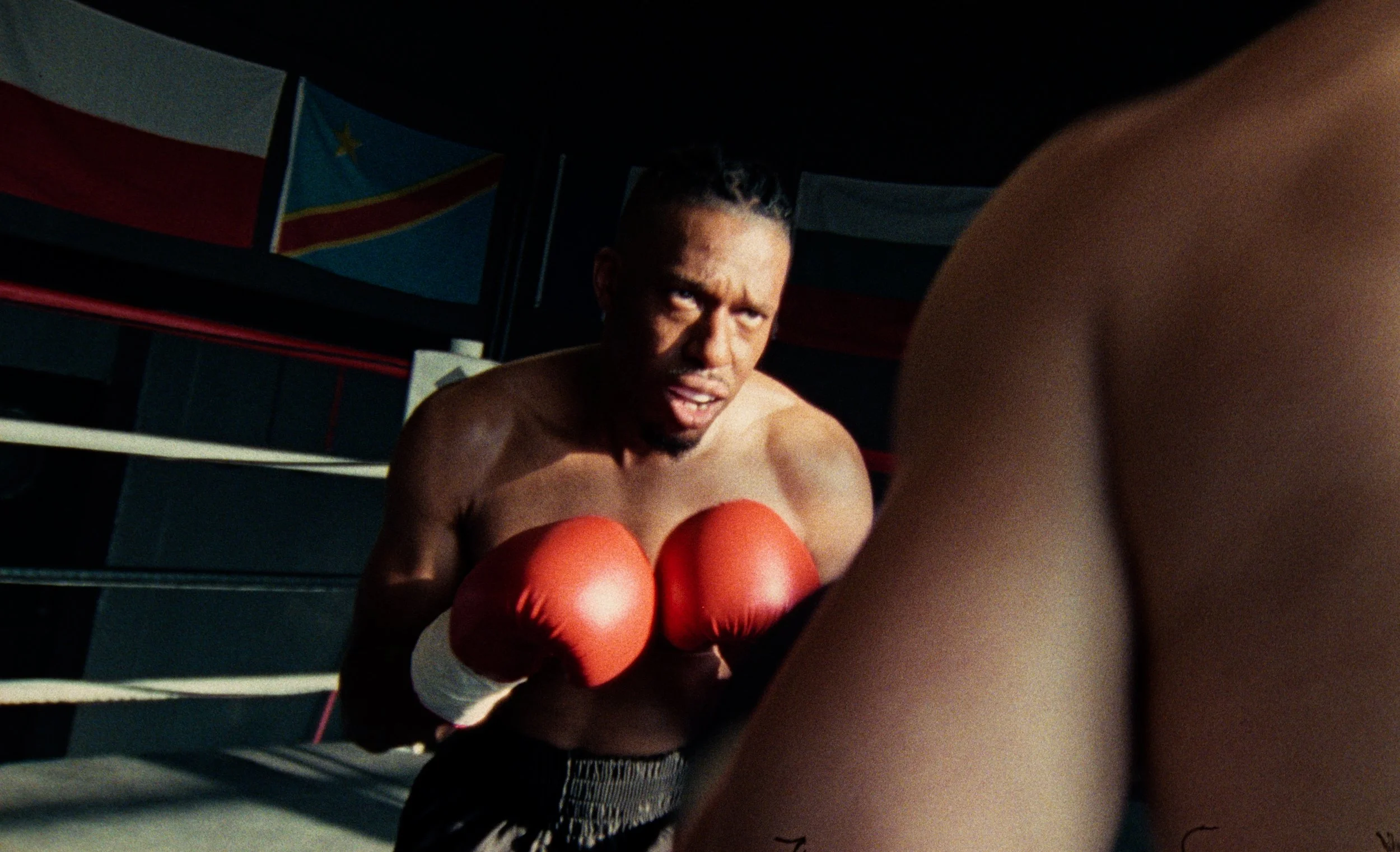
RA: I'm glad, because when I found that out six months afterwards that they had done that, I was astonished, because I thought it was just really brilliant cinematography from Stephen's part, and I thought it was beautiful choreography from Ewan's part, and then two great performances within that moment, and then finding out afterwards that they actually did hit each other for real in that one-er. It's quite astonishing, and you do feel those blows.
✽ Also your decision to shoot on film in a way pays respect to the discipline of boxing, they would have felt that as well.
RA: Oh, 100% Again, one of the things I learned through the making of this film is that boxing is a craft, and it's a masterful one at that, and it's a - you've said the words already - discipline. If I'm going to treat this craft of mine with discipline, I've got to treat the craft of boxing in a similar manner as well. Shooting on film raised our game, because there was always that notion of, well, the money's turning in that camera now. We can hear the money turning, so we can't fuck it up. We can't fuck this up. We have to be so prepared to a point where we're willing to take some blows and some failures, which is the exact same approach that a boxer takes when they are in the ring. We have to be able to be willing to take some hits, take some blows, and fall hard. And once everyone heard that film turning in the camera, everyone elevated themselves. There's also something very beautiful about the chemical process of film, which I think I love still to this day, which is knowing that we've shot something that is a hard print, you know, it's physically in your hand and it's beautiful, it's really beautiful. It also ties in nicely with the story we were telling, which is about imperfect realities, and you see the scratches in the grain on the film. We purposely left the scratches in the film when we digitized the film for editing. CineLab said, "Do you want them to be cleaned out?” I said, "No, keep them, keep them, because that's the imperfections of reality. There's always going to be scratches, there's always going to be marks, the reality we're creating is raw."
✽ Yeah, whilst watching, and the way you're describing it, I can relate it a lot to jamming and improvised performance, because it's that same thing. In the moment, I'm not going to be able to create a perfectly polished, structured three-piece song, but it's gonna be completely raw and completely an expression of what's going on that I may not even be able to express if I'm trying to, and it's a beautiful moment of surrender to we've got to elevate right now, we've all got to work together and listen and tune in even more.
RA: That's a really beautiful way of putting it, I would add to that by saying that we can strive for this notion of what we believe to be perfection, but does it really exist? I'm not so sure. I think we can be incredibly satisfied and content with work that we do. The worst thing that I've ever heard other people say, and in the past I've been criminal to saying; “that'll do”. I never want to be able to say that, and I hate that I hear people say that when it comes to filmmaking and cinema, or dare I say "content", right now. The two C's in our industry at battle with one another, cinema and content. People are willing to just say that'll do, whereas, as you beautifully and eloquently actually said, which is that expression to a point where you feel completely free and be like, oh yeah, now that for me is perfection, that's an idea of perfection, right. That being able to be so spontaneous and in the moment, it's important to feel that each time when you make something.
✽ Completely. Describe to me what it's like to be The Dark Kight
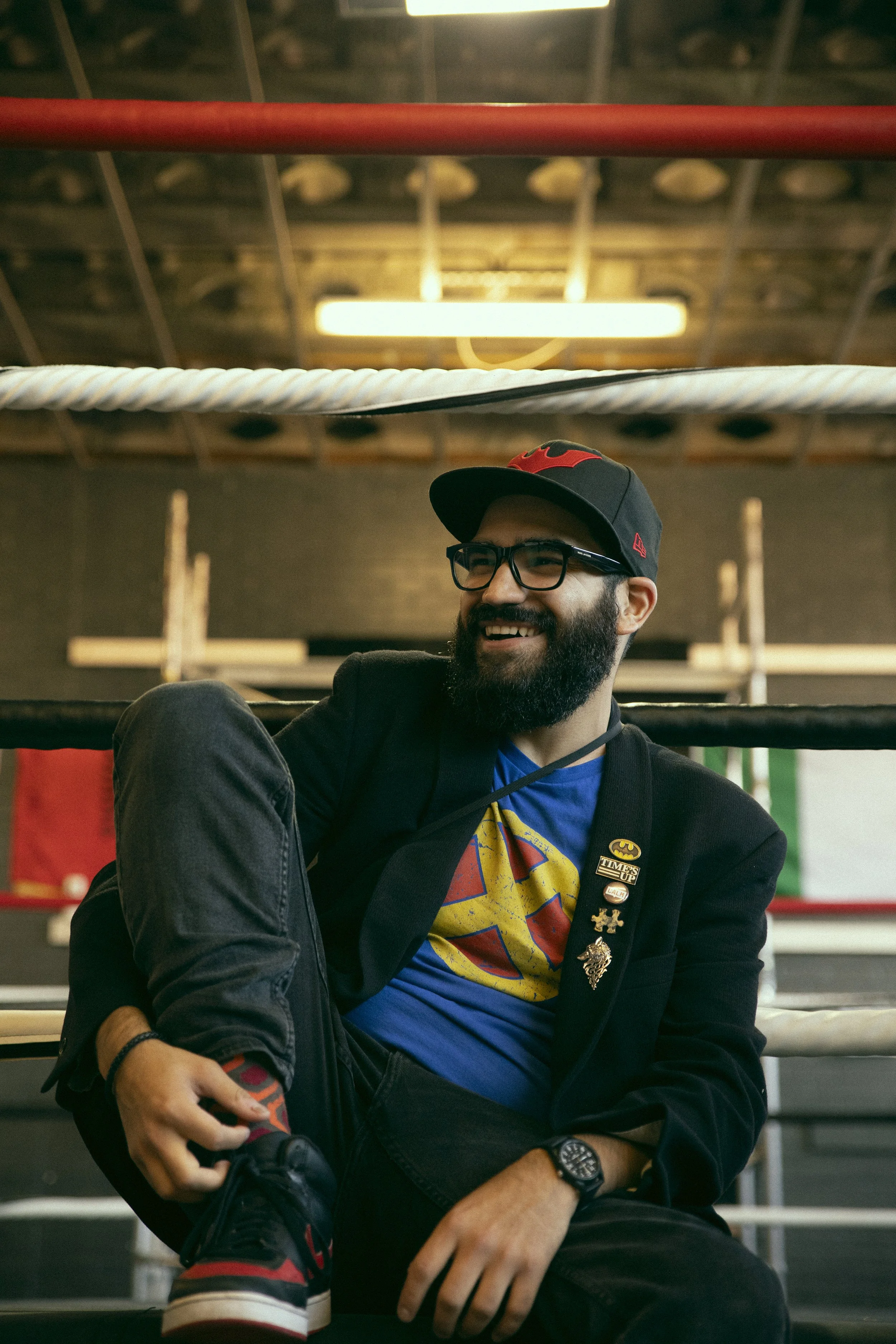
RA: The Dark Kight, it's bloody dope, I tell you (laughs). Look we're never in the same room, so you never know. No, but in all seriousness have a great fondness for the character, and I've made no secret of saying that (points to Batman hat). For me, that world and that character notably is very much like a father figure to me, especially when I lost mine at a very young age. So to tie in with the film as well, Punching Bagis about grief, and the struggles of being a single parent, and I was brought up by a single parent from the age of five. When you lose a parent, and then you turn to films and art, and in this case films and comic books, and you discover a character like that who channels grief and utilizes it to be his greatest weapon to combat crime against other people, it's immensily uplifting. A very powerful thing to learn as a child, to be able to go, 'oh yeah, that's what it means to be a human being, and I don't say man there, I mean human being'. You can either be the brightest knight or you can be the darkest night, and I think there's a fine balance between those two for me.
✽ What's your favorite comic book?
RA: The most obvious answer, but I am going to say it's probably Watchmen, Alan Moore's Watchmen is a masterpiece. I've always believed comic books to bring brighteness to otherwises dark times. In Watchmen, it flips that expectation. The characters are flipped them on themselves and Moore says no, these are actual "nutcases", these are "psychopaths", these are narcissists, these are sociopaths, these are people who are products of the Vietnam War and an uncertain time in America. All of a sudden you've got the Dr. Manhattan/Superman character to really shake up that world. To flip it on itself to say, well, what if actually destroying the world saves the world? That's a deeply dark and fascinating idea, and for me it’s a story that can't really ever be topped in the graphic novel sense. Once you go past the idea of, you know, to bring in another storyline, 'snap your fingers and half the population is wiped out', where else can you go from there? And withWatchmen, it's a giant squid monster, perhaps that doesn't hold up so well, but the idea alone of destroying the world, or at least half the world in some capacity, to rebuild it and to reshape it and to cleanse and bring togetherness and if that is the only to save the world? Is a very fascinating notion. Which I don't think has ever been topped. It's also incredible writing by Alan Moore. They're all flawed characters. There's maybe one or two decent, good human characters, but they're all incredibly flawed to the point where I would never say, "Oh, yeah, I identify with that character. Oh, I sympathize with that character. These are characters that I'm willing to follow on that journey, even if I don't like him, and that's a testament to the writing.
✽ Yeah, what he did was appeal to our desire for annihilation, even though we don't wish to be destroyed. The most powerful force, love requires complete annihilation. You are burnt in the fires of whatever that is, and something new comes out of it. Being able to put that in a so- called bad character and frame it in a story that seems like the worst possible outcome, but all of us go through that every day with a breakup or with a family.
RA: To take another storyline, Alan Moore's The Killing Joke. The idea of one bad day. I think we're all vulnerable to be in that position of one bad day. It ties in also with our own mental health and well-being. I believe one of the biggest achievements that we make every single day, is that we make it through the end of the day. We tend to forget this because we put so much pressure on ourselves with our jobs, and with making the right choice or trying to appease to other people's expectations of what people believe or want us to be. We're not always going to get it right. Even today, as of this morning, they've now passed the social media ban, so kids in schools they now have to be over 16 to be able to be on social media in the UK, which is a big change. I think there's a double edged sword when it comes to social media. For Instagram, it's essential for our business, because it's a way to showcase, and it's a way to express, and it's a way to say this is what I can do, but on the flip side of it, comparison is the thief of joy, when you look at other people on their profiles, and they highlight certain factors like how amazing this life or this aspect of life is, you have to remember that a lot of "influencers" out there are getting paid to do content like that. There's that dreaded word again. And with that, it can only harm rather than do good at times. At the end of the day, when you're looking or scrolling through, whether it's seven seconds of content or 15 seconds of content, it ultimately starts to have an impact in your mind of, “am I enough, am I doing enough, am I seeing what that person's doing and saying to myself, why aren't I doing that level of success”.
You define what success means to you, so if success means getting through the end of the day for a lot of people, whether it's bringing up kids on their own or doing a certain job which takes over their lives, or, and not to go too deep into this, just trying to survive the consequences of war going on right now. Just being able to get through the end of the day is one of the biggest achievements we make every single day,
✽ Even to raise yourself up out of bed. I've been finding the past few weeks, the morning will start so heavy physically, and then towards the end of the night, especially after performing, I have this lightness. I'm realizing it’s a microcosm of the human life journey, you start off with this heaviness and strive towards lightness and bringing more love to the people around you.
RA: Absolutely. Another thing you just mentioned there, surrounding yourself with people that support and love you, is such a big factor, that's something I've learned over time, not just outside of the industry, but outside it, having that support network that's there. It’s also good to have those people that can be very blunt, because it is a healthy thing to have that. It can't just all be yes, yes, yes. There has to be the people that say, well, actually no.
✽ Thank you to Producers. The ones that say “No! We can’t make a beating heart that's gonna walk by itself and then fly, that's gonna cost 10 grand. Let's maybe not do that”.
✽ We’ll end it off with this question. Recently, I've been seeing art as the art of changing consciousness through time. As a master of time, how are you trying to change people's consciousness through your works? What is your message at the moment?
RA: wow, ah
✽ nice easy one. Yeah,
RA: Would have loved a heads up on that one (laughs). First of all, I wouldn't say I'm a master of time. I don't think anyone can really be that. There's a quote by one of my favorite film directors, Stanley Kubrick, who says “the structure of time is suspense”, and I've always loved that. I apply that with all the film work that I do going forward, which is (holding breath)...holding a shot, holding a moment, because I think to answer with your question, the measure of time right now can guarantee more audiences than just one, and what I mean by that is, if we spent longer than 15 seconds watching a piece of content or film or whatever peice of art, I think we would have a better understanding of the world. That's something we've lost over time. As our attention span has grown shorter, we've lost perspective, and I think we've lost what makes our craft, a craft, and that's why I said earlier the two C's in our industry (cinema and content), I am supportive of one over the other, try and guess which one (laughs). I am a filmmaker that first and foremost wants to entertain, but also has something to say, but also uses this craft to heal. I am a film director that treats this as an art form where if wounds open up in my life, I use filmmaking as a tool to heal, to sew up the 'open wounds of life' through the power of film editing, and that happens through time. Time is an ally, never an enemy. I hope that answers your question.
✽ perfectly. If you can, would you be able to tell the people a little bit about what projects you have coming up?
RA: I can. I am currently working / developing two feature films. One of them has been outlined, this is the second feature, and it's my perspective, 'love' for pro wrestling. It's about the politics of the pro wrestling industry. Think Boogie Nightsmeets WWE. It’s my love letter, but also an open debate of that sport and its complicated relationship with the entertainment industry, where we are now, and where we are politically on that landscape of things. The first feature, which I have written, and am now getting the team together, is about my experience of working in a coffee shop. For 4 years, roughly 13 years ago, I was a barista at a known American coffee shop chain. It's a story about toxicity, working in a hospitality environment, and how that level of toxicity can, pardon the pun, "brew" over time to the point where it can change you and our perspective on the world entirely. Think Scorsese's Taxi Driver in a coffee shop.
✽ I think you have about 80% of the population already waiting to watch this.
RA: I don't want to be too negative towards the end of this now, because I've had a good chat, by the way. The world right now is very complicated and very angry. At the Kingston International Film Festival, Mike Leigh even spoke about the troubling times that we're in. The cost of living crisis is at a high. People are uncertain about what this government is doing for the people, for the working class, for the underrepresented, what more can be done. With the story that I'm trying to tell, firstly, it is about the underrepresented, it is about the working class, and it's also about at its core, what does loneliness look like in an otherwise or supposedly connected time in our lives with things like social media. So what does that look like in the hospitality industry. From my perspective, it's toxic.
✽ For me, it's a very beautiful era that we're in, because we're being given the chance as the people to come together and actually build new ways of structuring our reality, new ways of helping out people, new ways of connecting more nodally, instead of one person up, and it's a great time to be given the opportunity to actually say, “okay, you guys clearly have no idea what you're doing, and you don't have our best interests at heart. So we're just gonna keep our resources to ourselves and build from the ground up”. I think it's doing art festivals, all these things that we're doing, it's already happening, and people are connecting more.
RA: Yeah, absolutely. This is why I always say that social media is such a double-edged sword. On the one hand that connectivity should always be there in a safe capacity, that you and I, even meeting in person, that's been the natural form of connectivity, and we've been able to have this open conversation without us looking at our phones, we've just been fixated on us talking to one another right now, letting the work and us do the talking. Now, the irony is I actually struggle to open up. I struggle to talk, which is weird, because I've been talking quite a lot for 30 minutes. But that's where films come in for me. From an early age, as I mentioned, when you lose a key figure in your life and you suddenly feel contained, not quite sure what the perspective of the world is supposed to be from that point onwards. What's the only thing you could turn to? Yes, the other parent in question, who now has to embody two parents, but then there's art. That opens up the perspective, or a perspective that you other wouldn't have known otherwise. That's why I think it's always important when you go to things like festivals, or conventions, or concerts, and you get that different perspective and different notion of what the world is offering you, you have whole new ideas of what those perspectives are, and you get a better understanding of what the world is around you.
