Meet The Designer—An Interview with Anya Tsen about A Place For Making, A Place For Learning
✽ Introduce yourself for the People
AT: Hi, I'm Anya Tsen. I'm a graphic designer and I'm particularly interested in editorial design and book arts; the space of a book and the tactility of the reading experience.
✽ Do you remember the first art book that you picked up, the sparked your interest in this form of design?
AT: I’d say it's probably actually a book, my mum made. She's not an artist in a professional capacity, but she's very creative and she makes jewellery and does a lot of sewing. I remember when I was maybe six or seven, she made a little picture book and it was a concertina, had deckled edges, and the paper was all handmade. It was illustrations of a plant that she drew. But I remember thinking that was a really fun, exciting book. I found it recently, and, yeah, it was really nice to think that I always had creativity around me. I'd say that's probably the first book that really made me think about books differently.
✽ What was your inspiration for a place for learning, a place for making?
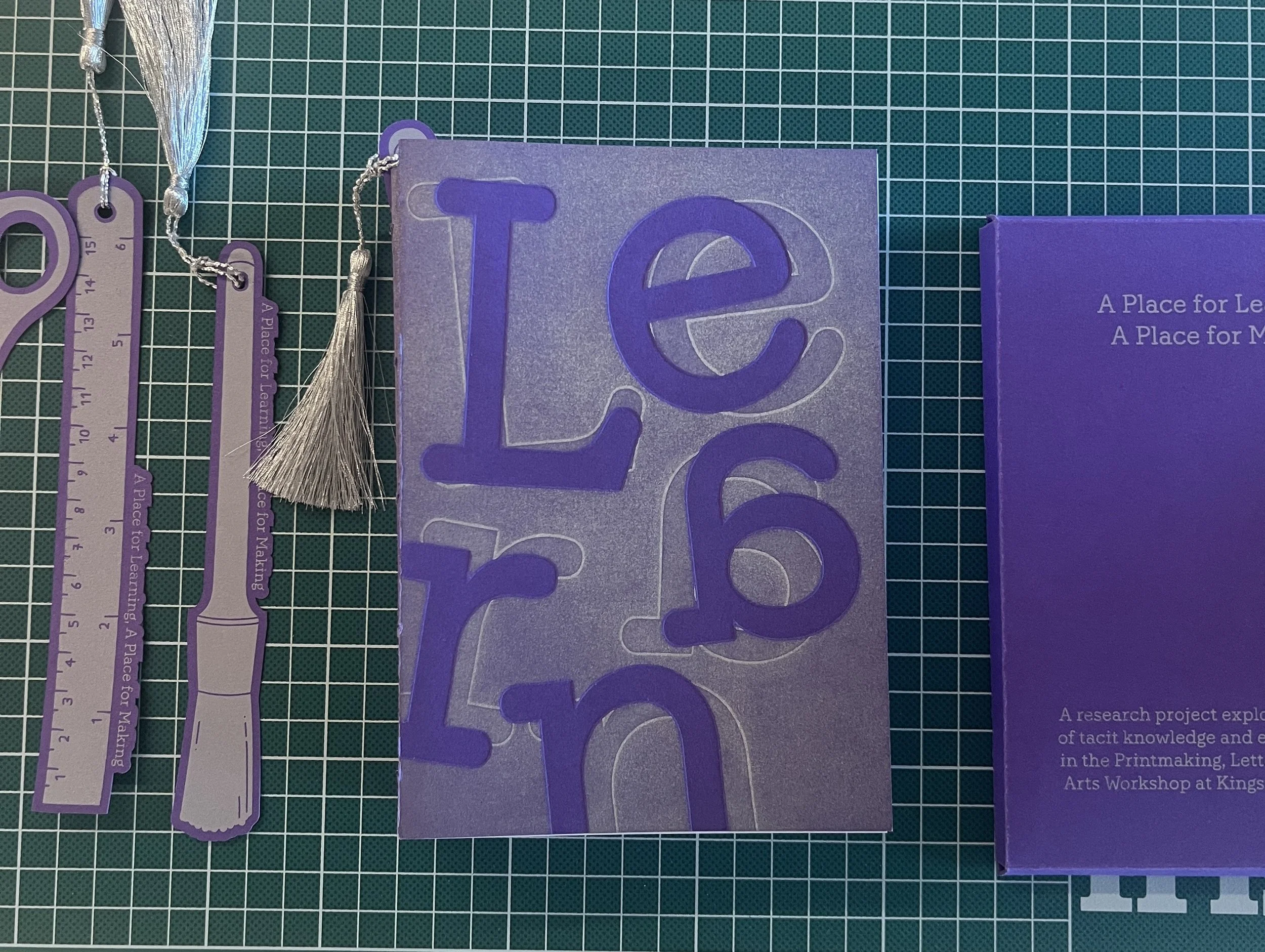
AT: A place for learning, a place for making was inspired by the print making, letter press and book arts workshop we have here at Kingston University and how I feel that it's a really inspiring and wonderful space for students to learn and make new things.
✽ There’s a part in your dissertation where you're talking about how much communication goes on with the hands and how sensory we are as humans and our experience with that. Can you tell me a little bit about how you've evolved that in your practice or how you want to engage people in that thought?
AT: As in the experience of doing things, by hand, did that make sense? I guess I feel like in my own practice, I've really come to understand my work by making things physically. And that tends to be a lot of publications. And I think reflecting that for the reader through, whether it's debossing, the paper stock, and really letting sense speak for itself, really lends a new.. like a new way of looking at things and understanding, content the way that the designer imagined it.
✽ Is there a sense beyond the physical that guides you in your making at all?
AT: I think I'm really inspired by repetition. The sense that you really need to do something a lot to understand it and whether that's wanting to make a lot of one thing or make a lot of something, but in a lot of different ways, that sense, I see in my practice.
✽ Through all the projects and through your journey at university, what do you feel like you've learned about yourself through making?
AT: I think I definitely have come to understand myself as a craftsperson, and I think craft kind of has a reputation sometimes to feel a bit kitschy, which I don't see as a bad thing, but also sort of understanding craft as a mindset. There's a really nice book by Richard Sennett called The Craftsman, and he writes about how everybody is a craftsman, not just people engaged in craft. I'm saying craft a lot. But a craftsman is someone who, in whatever they do, they want it to be the best it can be, and they put all the effort into all the different facets; if it's an object that they're making, or I don't know, an experience they’re constructing. I've actually been here for five years I did my foundation here, and I’ve really come to understand myself as a crafts person in that sense.
✽ Great. What are your next steps? What are you looking forward to?
AT: My next steps. I'm quite fortunate to have a job lined up at a graphic design studio in London called Callen Burger White and a lot of their work engages with touch and craft and translating the human sense into graphic design, identities and exhibitions is mainly what they do. But alongside that, I want to continue expanding my book arts practice, and it's something I do dedicate a lot of time to just for fun in that sense. So I think that's the direction that I'm heading in.
✽ If you could employ someone and pay them £20 an hour to help you with anything within your creative practice, what would you have them help you doing?
AS: Have them help me doing. Well, right now I'm in the process of binding, like 20 books. So it wouldn't be very inspiring, but I probably, if it was right this second, I'd be employing them to help me bind those.
✽ I know a lot of people that would want to do that. What's the binding for this?
AT: This is just an exposed bine.. Kettle stitch? Yeah. And I'd say it's quite simple, but maybe because I've made a lot of things.
✽ For anyone that doesn't know what a kettle stitch is, can you describe it through words, the process of kettle stitching?
AT: It's a book with multiple signatures and signatures are stacks of paper that you'd fold in half typically in multiples of four. Typically, but there's no right or wrong number and you stack those on top of each other and punch holes at least three holes per signature, but there could be more, and then you go in through the bottom one and then put the next one on top and then loop them around and then continually loop all of your signatures together until you finished binding.
✽Tell us about your photo book project, 'Statues of Liberty', a collaboration with Steven Siegel
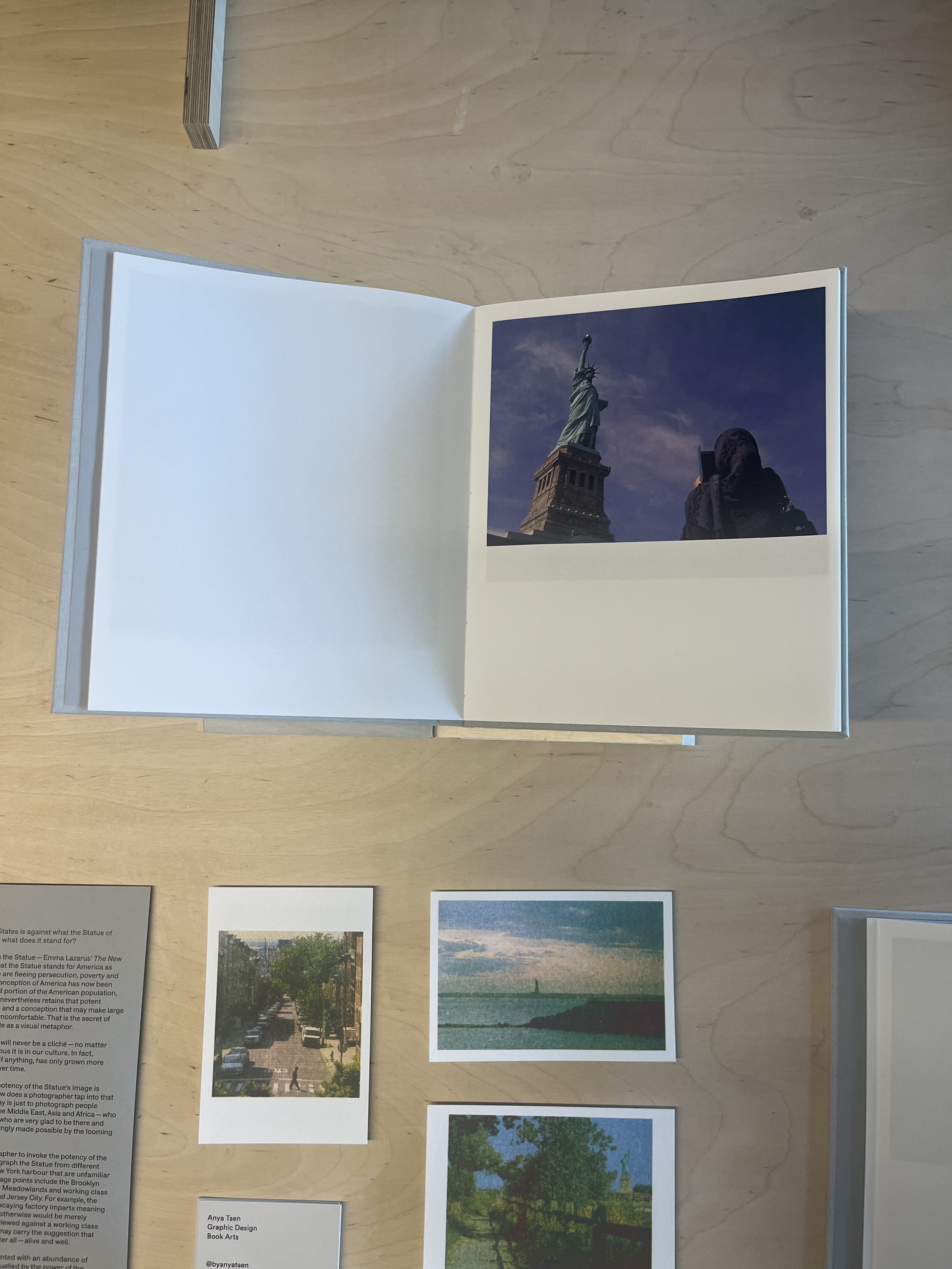
AT: The project 'Statues of Liberty' is in collaboration with a New York-based photographer, Steven Siegel, an amateur photographer. I don't really like using the word amateur in any sense, but by definition he's an amateur photographer, his day job, he's a lawyer. He's been photographing New York since the 80s, so he has a 45 year archive of New York changing, and has a wealth of knowledge. He's obviously very intelligent, but he also has a creative part to him, and he expresses that through his photography. I found his work on the ICP website, and I found it quite interesting, I couldn't really put my finger on why. He has these different essays on his website that he's written about the subjects of his photos, and one of them was about the Statue of Liberty. In his work what really stuck with me was this relationship between his writing and the photographs. He has these interesting ideas about what, say the Brooklyn Bridge or the Statue of Liberty represents. Just having the text or just having the image doesn't do those thoughts justice. I feel like combining both of them is really when you get a picture of how he understands the world. So I reached out to him, and I was fortunate enough to interview him, and the output of all of that research is this photo book that I made.
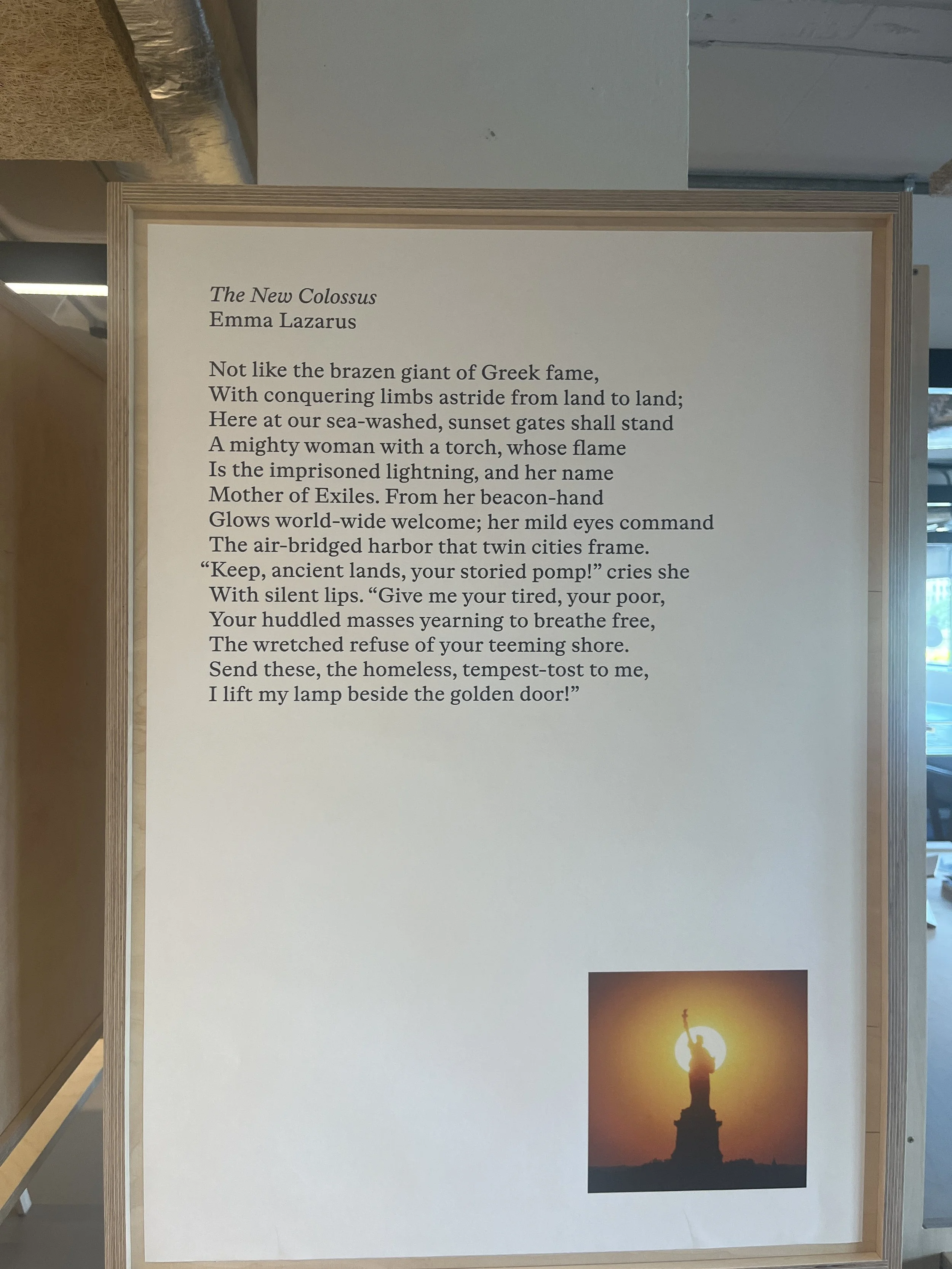
AT: I'll talk first about the actual design aspects of it. It's got a French link stitch, which is a little nod to the origins of the Statue of Liberty, it was a gift from the French to America, I think lots of people know that, but also lots of people don't. But, if you know the history, it's a nice little detail. On the cover, is the poem that's inscribed at the bottom of the Statue of Liberty, The New Colossus by Emma Lazarus, it's this sonnet about America as this idea of freedom and being open to immigration, which I think is a really interesting idea. It's not, not really true anymore. I think you can say that, but like originally what it was meant to represent, and how that idea is now really quite controversial.
✽Is the front cover embossed or is that printed?
AT: It's screen printed, and it's also got the title and its name on the spine. Yeah, the book is laid out in the way that he wrote his essay about the Statue of Liberty. He wrote about how your understanding of the statue really can change depending what it's surrounded by. It's taken the photos of the statue, some of it are from across the water, some of it are further away, and you get some with affluent communities in the foreground, or you get a factory in the foreground, or an abandoned railroad, and how all of that encapsulates the idea of the statue. It can be so many different things, a symbol of hope, or it can be a relic of the past. And I thought that was a nice thing about photography, so I sequenced it as if you were moving around the statue, as if it were moving. So if you start looking through the book, it's quite hard to see, because the sizes don't line up, but it almost rotates, and the first and last image are both the same.
✽You've made a circle within the square.
AT: That's actually in his crop. In his interview, we spoke, and I asked, because some of his images really weirdly cropped, and I knew that he shot film, so obviously that was a choice, or any crop is a choice, but yeah, he really, really wanted it to look that way. He said that he thought the crop as a photographic device was really powerful, you could really frame what you wanted, so all of the photos were left the way that he cropped them. To stay true to that sentiment.