‘Beyond the Ring’: Exploring the World of Boxing through Performance and Narrative
Abstract
This dissertation explores boxing as a form of performance, examined through the narrative frameworks and structure of theatre. Narrative acts as an intersection between pugilism and performance, revealing underlying meaning. Using theatre to unpick boxing, allows for viewers to understand the sport out of the bounds of anger and violence, the sport is not about two people punching eachother, it is the art of not getting hit. Instead of arguing, I am revealing the control, confidence and mental discipline that is gained from the physical, emotional and phsycological forces of boxing; In an exhibition format, I am celebrating the attributes of boxing that becomes integral to a boxers everyday life. My dissertation includes experiences of my late father, who was a boxing coach, to situate and highlight the personal dimensions of the sport. Using a reflective meathodological approach, I am holding interviews, examining my dads belongings and collecting imagery from matches. Taking account of the themes I used to organise and construct my gatherings, (the performer, the performance, the costume, the ring, social and political experiences and the mentality), I am going to discuss the ways in which boxing is a vital cultural sport in which the responsibility, identity and discipline are taught. Through my findings, I will order and organise my findings in similar structure to the build up of a boxing match.
Introduction
I have chosen to situate my dissertation around the world of boxing, a sport that I have grown up surrounded by despite not participating myself. My dad was a professional boxing coach. Day and night, the television in our house played boxing matches, the commentary on full blast whilst he deliberated on his phone at an equally concerning loud volume with his fellow sportsmen as to who would win and why, (see fig 3). I was always intrigued as to what my dad would be talking about when athletes, friends and clients came over to visit. He was, as Derek Chisora (the ex- European and British heavyweight champion) described him, the aficionado of boxing, or as my mum described in his eulogy, “If Muhammad Ali was the professor, then my husband was the philosopher of boxing.”
In the last few years, I have realised the ways in which boxing had rubbed off on his parenting, showing me how the disciplines of boxing permeate into everyday life. Experiencing this, I learnt about boxing the ‘opposite’ way around. Instead of participating in boxing and learning what its disciplines offer you, I have been taught life’s lessons without understanding the context of where they originated from. When explaining a problem or in need of advice, my dad’s first response would start with, ‘Well in the ring...’ He would convert my problems into a moment of training in the gym, an attack in the ring, a sprint up Primrose Hill, or a pause when one had to analyse what the opponent would do next. In the eight months since my dad passed away, his words of wisdom have coached me through my grief. My memories of him in our family are never without his many boxing philosophies; stories that have sparked my interest into why the sport of boxing has impact far greater that the punches thrown. How it’s lessons and narrative exceed beyond the ring.
Narrative Alongside Boxing
My start point was to collect stories to sit alongside my own and those of my family. The recurring thread of those that have been shared with me, is that they all end with a lesson and a moment of teaching. Theatre and drama share this similarity. Every Shakespearean play end with a moral or lesson to be learnt at its finale whether tragedy, comedy or love story. The harder the lesson to be learnt, the greater impact it leaves on you, and the more memorable that lesson, the longer it lasts. Both Shakespeare’s original script Hamlet and Hamnet (Universal Pictures UK 2026) are great examples of this. You cannot help but to parallel your own life to the story that has played out in front of you. It touches something inside of you that consoles or reassures you as if an ally.
My goal is that my exhibition will unpack the themes that frame both the backstory and fruition of a boxing match, walking through the origins of boxing, the psyche of a boxer and his motivations, and how the fight unfolds. But importantly, that it never ends at the count, or the bell. Looking through my dad’s things, I have a cherished list he made of the most important aspects in life to consider. Taking inspiration from this, I have attempted to categorise the most important factors in boxing.
Boxing as a sport is far more than two protagonists pounding each other with an audience baying for blood. My exhibition attempts to deconstruct how boxing is a unique and vital discipline for life-changing emotional and psychological improvement. Deconstructing boxing reveals why these resilient, brave and supremely fit athletes keep relentlessly returning to a sport steeped in danger and pain. Pain can be a tool to learn, in the same way that I am using boxing research to understand about grief. Boxing is far more the punch it delivers.
“I started the familiar procession down the aisle, a strange and special ritual unlike any other in sports, cheered on by the hungry masses out for blood, marching to glory or shame or, worse, death... the Sweet Science...had chosen us.”
Sugar Ray Leonard, The Big Fight, Ebury Press, 2011 (Sugar Ray Leonard versus Marvin Hagler April 6th 1987)
Pierre Egan, a sportswriter in 1813, described the blend of strategy, skill, and toughness required in bare-knuckle prize fighting as the ‘sweet science of bruising’, a term now used to describe boxing as the ‘sweet science’. The technical complexity, resilience and strategic depth required make this sport a ‘mental and physical chess-match’.
“In boxing, you create a strategy to beat each new opponent, it’s just like chess.”
Lennox Lewis, 2022 vs Hasim Rahman
My dad, a great fan and friend of Lenox Lewis, used to simplify it down to ‘the art of not being hit’, but that, is no easy feat. His follow-up quote was far more instructive if a pugilist was to avoid a punch - ‘Failing to prepare is preparing to fail’ - a lesson that can be applied to most aspects in life.
Viewing boxing through the lens of theatre deconstructs the natures of power and identity through conflict and confrontation. Dramatizing real aspects of society and our own personal trials through narrative allows us to process our problems externally, granting us the space to reflect and organise chaos. Dealing with the mental challenge of confrontation is something we all have to face in life, and watching the drama of a fighter losing his temper in a weigh in, or how a boxer must exit the ring with dignity after a humiliating loss (and there are few things as sudden and silencing as a fierce knock-out) allows us to question how we would act if we were in that position.
Narrative is crucial for audiences to understand the journey and mental exercise behind a boxer’s psyche in a less confronting form; the storytelling of the favourite versus the underdog pulls the audience in just as much as the fighter’s skill and talent. Theatre and boxing have many intersections with their use of hero types and character making e.g. the undefeated hero, the underdog, the journeyman, the comeback fighter. This allows audiences to connect with fighters, choosing who whey hope to win or lose. and feel discernment for the one they hope will lose. As a boxer, anchoring onto these archetypes can help construct their own character and identity in the ring, which can aid in blanketing their own fears and mental blocks. This can further blend the lines between the mask of theatre and the actor as an individual - is this real or is this what boxing shapes you to be? Evaluating the ring as a stage, and the satin embroidered boxing shorts and hooded robe as costume, the performance of boxing comes into fruition.
Breaking down Performance and the Performer
One of the great examples of a fighter’s narratives involves the Eubanks and Benn families. Listed as one of Boxing News’s 100 Greatest Fights of all-time (iD Sports Media), both fighters were theatrical performers, their family feud as fierce as any Shakespearean drama. The magazine described Nigel Benn as the ‘marauding battler, the Dark Destroyer’ and Chris Eubanks as the ‘eccentric warrior’ (his three-piece Jermyn Street tailoring and monocle as his outside ring attire). Their 1990 battle was explained as ‘neither could tolerate losing to his nemesis and fought with unrelenting fury before a howling atmosphere’ (see fig 21). Today their respective sons continue the families’ feud except we see a very different side to their respective fathers’ characters now that they have left the ring and learnt lessons. Following the fight in April 2025 which Conor Benn lost, his father, the once Dark Destroyer, is seen embracing and holding his son for a long time rather than offering immediate critique, (see fig 24). His gesture was hailed as an example of powerful paternal support and the profound connection between father and son that transcended the result of the match. It was an example of the vital emotional support needed in such a tough sport. Occurring in the same year as the Golden Globe winning drama Adolescence (Netflix, Jack Thorne and Stephen Graham), it highlighted the emotional support needed when life gets tough for young people. Benn said he was, “Unbelievably proud... you gave it your all. Now go back to the drawing board and rewatch the fight. The best is yet to come.”(Instagram, 2025) Conor avenged his nemesis, Chris Eubank Jr. in November 2025.
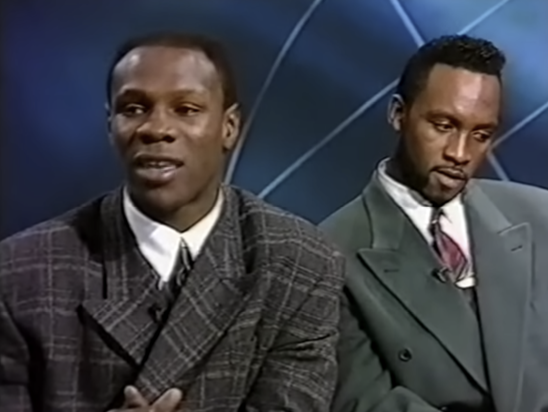
(above) In an interview Benn and Eubanks sit facing away from eachother. Benn comments, ‘I personally do have him) (Internet Champ,2018)
For Chris Eubank Sr., we also witnessed a new character far removed from his bravado showman character in the ring. He expressed deep remorse for the career-ending, near-fatal damage Michael Watson suffered in their fight in 1990, breaking down publicly in an interview with Piers Morgan and calling it his biggest regret. (see fig 23)
“All fighters have some respect for each other however deep that ‘hatred’ runs.”
Adam Smith, Head of boxing, Sky Sports
The ancient statue ‘Boxer at Rest’ encapsulates this humility in boxing when one has been defeated which I wanted to instil in the viewer, (see fig 4) The sculpture, circa 100 BCE, is an excellent example of the Hellenistic period in which casting bronze was considered a luxury. The boxer is slouched yet grounded unlike the upright, heroic marble depictions of athletes of the time; he is defeated. In addition to his broken nose, cauliflower ears and scrapes, the blotchy patina on the bronze gives out hues of red as bruises. His turned head suggests that he is looking away or is in dialogue; the artist has caught him in the moment, reflecting his loss.
‘Prince’ Naseem Hamed was notorious for using the ring as a catwalk. A boxer’s costume transforms him from the sweating athlete into any character he imagines whether royalty, a glitzy Vegas showman or a Hollywood superhero. His costume and his choice of entrance music aligned to his character, transformed the sporting event into a theatrical performance and created a sense of make-believe for the audience. Accompanied by his own dance-style (a punching motion), ‘Prince’ Hamed embraced his unconventional wardrobe to confuse and distract his opponent; his iconic leopard shorts as much a part of his signature as his leaping left hook,(see fig 6). His bold fashion sense further awarded him the title of ‘Best Dressed Man’ in 1997, before defending his WBO title against Kevin Kelly the same year.
Naseem’s ring walk was performance art. Against Wayne McCullen in 1998, he captivated the audience with the help of props, dramatic lighting and smoke machines. Barry McGuigan commentating described him as looking like ‘Michael Jackson or a belly dancer’, (see fig 5). Similarly, Floyd Mayweather entered his arena in a Roman army costume to instil in his audience a sense of his heroic powers when he fought Carlos Baldomir in 2006, (see fig 7). He allowed his narcissism and puffed-up ego to remove the possibility of any doubt within his psyche. Larry Merchant, the commentator for HBO, said, ‘If he was a peacock, he wouldn’t fold his feathers’(HBO,2019), to which Mayweather replied,
“You just a commentator, stick to commentating.”
(HBO,2019)
Despite the theatrical excess that the promoters and broadcasting channels create to attract multi-million dollar pay-per-view audiences to their arenas, boxing as a sport is very much real life. The blows thrown cause damage. This is the terrifying reality check.
“Their job is to bring two combustible elements together in order to sell and market the fight.”
Adam Smith, Head of boxing, Sky Sports
From a spectator’s point of view, the drama can be equally as engaging as the fighter’s technique. My mum told me many stories about her near escapes from boxing matches when the crowd erupted into chaos after the favourite didn’t win, (see fig 8). My dad, working as the cornerman, would gesture at my mum to make a run. A personal insight into how the audience can become mediators of the sport.
What the audiences pay to see however is the spectacle of when a boxer loses control and let’s their anger and aggression out untamed as if they have released an uncontrollable beast. It affirms the primal act of fighting, fracturing the myth about stoic boxers and their ability to discipline their emotions that the iconic Rocky films (1976-2006, United Artists and MGM Studios) portrayed through the sensitive role play of actor Sylvester Stallone. Robert de Niro on the other hand, was the antithesis of this in the film aptly named Raging Bull (Martin Scorsese, MGM Studios 1980). While Rocky (and the follow-up films Creed) celebrated the heart of a boxer, Raging Bull was a visceral, naked, look at rage and self-destruction. The performance earned De Niro an Oscar. Mike Tysons fight with Evander Holyfield in 1997 earned him the loss of his boxing licence rather than an honour. An example of the performer going off script, frustrated by Holyfield’s headbutting and holding, Tyson bit Holyfield’s right ear in the third round, leaving him squirming in pain (see fig 9 and 10). The bout was stopped in the next round after Tyson’s second attempt to tear off the ear, leading to police intervention to contain the indestructible monster, (see fig 11).
In 2003, Tyson’s sacred Maori-inspired tattoo encapsulated his aggressive demeanour; a scar to represent his warrior status and reclaim his narrative - if people thought him a monster, then he would look like one.
Press conferences after weigh-ins present the opportunity to mentally spar with your opponent. Psychological warfare erupted in the conference between Derek Chisora and Dillian Whyte. Whyte’s verbal jabs at Chisora, suggesting that he will fight him on the street played with Chisora’s patience. After rounds of interrupting and digging at each other, Chisora resorted to throwing a table at him which the press lapped up with glee (see fig 12).
On the contrary, Muhammed Ali’s embrace of Islam elevated his craft, using
moral discipline and humility to conquer his opponents with ease. My mother met Ali on a flight from Los Angeles. Approaching him for an autograph, he pulled a leaflet from his breast pocket to write on, handing her a signed copy of the message of Islam (see fig 14). Rejecting his ‘slave name’, Cassius Clay, Ali makes use of his platform, allowing non-white voices a space to speak, confronting injustices prevalent in the 1960’s. From his early rhyming monologues predicting which round his opponent would fall in, he soon established himself as a great orator, entertainer and political campaigner, (see fig 13). Following his conviction in 1967 for refusing to fight against Vietnam he said, “I ain’t got no quarrel with them Vietcong. My conscience won’t let me go shoot my brother or some poor hungry people in the mud for America.” He chose to fight for freedom and equality for Black Americans and not a foreign war. His engaging interviews with chat show host Michael Parkinson (who said Ali was his favourite guest on his show), ensured he was voted the greatest athlete of all time by the United Kingdom public in 2000. For such a powerful fighter, his aura was always that of a compassionate, wise gentleman who made profound observations about mankind.
“He who is not courageous enough to take risks will accomplish nothing in life... but courage without control is chaos” (Brainyquote,2016)
Muhammed Ali - Chicago Tribunal
Conclusion
Through boxing, the softest parts, vulnerabilities and sentimentalities of ones mind start to reveal themselves. Talking to the boxer Leon ‘Solid’ Williams, his processing of childhood trauma through the ring provided him strength as a fighter. We continue learning, putting our lessons into practice until we improve or succeed however hard, returning to learn more, (see fig 25). Narrative is a tool to highlight to realise of your own pain, fears and worries in which the psychological and social factors behind boxing leads to moments of enlightenment. In my exhibition, weaving my own personal narrative about my dad, his experiences of boxing, has taught me about boxing, life and especially about love. Curating my own narrative through my collative outcome has given me understanding about my world of boxing through grief.
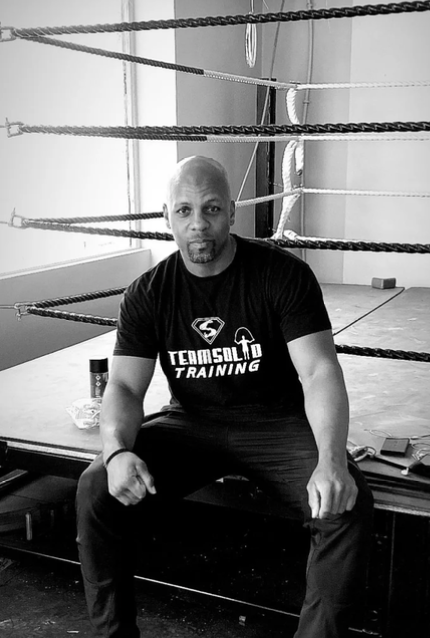
Leon ‘Solid’ Williams (Team Solid Training,2025)
“Boxing in all its literal and symbolic glory relates to the larger human issues this brutal sport has come to symbolise and embody”
The Greatest Boxing Stories Ever Told, Jeff Silverman, First Lyons Press, 2004
Statement of AI Contribution: I used AI to help find my academic journals and cite some of my references.
Bibliography
Baddeley, N. (2021). What happened between Chris Eubank and Michael Watson? Boxing match and marathon. [online] The Argus. Available at:https://www.theargus.co.uk/news/19101366.happened-chris-eubank-vs-michael-watson-fight/.
BeanymanSports. “Dereck Chisora Throws a TABLE at Dillian Whyte during Explosive Pre-Fight Press Conference.” YouTube, Youtube, 7 Dec. 2016, www.youtube.com/watch?v=gBUDyRiQo2s. Accessed 16 Jan. 2026.
Benn, N. (2025). ‘Unbelievably Proud of my boy, you gave it your all. Now time to go back to the drawing board and rewatch the fight. The best is yet to come from my son Conor Benn’. [digital photography] https://www.instagram.com/p/DI7b1mFhvSV/. Available at: https://www.instagram.com/p/DI7b1mFhvSV/ [Accessed Jan. 14AD].
Bossi, A. (2025). Chris Eubank Jr vs Conor Benn: Is Boxing Fashion’s Next Sport Obsession? [online] Vogue. Available at: https://www.vogue.com/article/is-boxing-fashions-next-sport-obsession [Accessed 16 Jan. 2026]. Boxer at Rest. (n.d.). [digital photography] wikapedia. Available at: https://en.wikipedia.org/wiki/Boxer_at_Rest [Accessed 11 Jan. 2026].
Boxraw (2025). The Greatest Boxing Fights Ever. [online] BOXRAW. Available at: https://uk.boxraw.com/blogs/blog/the-greatest-boxing-fights-ever?srsltid=AfmBOoozaJjcu-S7JxBEj4iRO3DOUyb MC7DDPL1rBOFEyQF7Fk-Die8n [Accessed 16 Jan. 2026].
Boxrec.com. (2024). Nigel Benn vs. Gerald McClellan - BoxRec. [online] Available at: https://boxrec.com/wiki/index.php/Nigel_Benn_vs._Gerald_McClellan [Accessed 16 Jan. 2026].
BrainyQuote. (2019). BrainyQuote. [online] Available at: https://www.brainyquote.com/quotes/muhammad_ali_148633 [Accessed 12 Jan. 2026].
Bhumika Sharma, B. (2024). Dramatic Reflections: The Intersection of Social Issues and Theater. [online] The Ariels. Available at: https://thearielsblog.wordpress.com/2024/10/27/dramatic-reflections-the-intersection-of-social-issues-and-theater/ ?utm_source=chatgpt.com [Accessed 16 Jan. 2026].
Carlson, D. (2018). Floyd Mayweather Jr. and the 25 Wildest Boxing Entrance Costumes. [online] Bleacherreport.com. Available at: https://bleacherreport.com/articles/545009-floyd-mayweather-jr-and-the-25-wildest-boxing-entrance-costumes [Accessed 16 Jan. 2026].
Center, A.E. (2023). In His Own Words - Muhammad Ali Center. [online] alicenter.org. Available at: https://alicenter.org/meet-ali/in-his-own-words/ ‘In his own words’ page.
Davie, C. (2025). Daniel Dubois house party video emerges after Oleksandr Usyk defeat. [online] Metro. Available at: https://metro.co.uk/2025/07/22/daniel-dubois-house-party-video-emerges-oleksandr-usyk-defeat-23719297/ [Accessed 16 Jan. 2026].
Decca Aitkenhead (2019). Tyson Fury interview: The Boxer On Fighting Depression And His Inner Demons. [online] Thetimes.com. Available at: https://www.thetimes.com/culture/tv-radio/article/tyson-fury-interview-the-boxer-on-fighting-depression-and-his-in ner-demons-g56wnztdr [Accessed 16 Jan. 2026].
de Vos, E., Mansfield, L. and Stephens, N. (2025) ‘Fighting fit: Clothing, equipment and material objects as Identity Formation in women’s boxing’, Annals of Leisure Research, 28(3), pp. 399–418. doi:10.1080/11745398.2025.2524024.
Digital Theatre+ and Boal, A. (2024) Theatre of the oppressed. S.l.: Instituto Augusto Boal.
Dooley, T. (2009). Our Unseen Heritage: Chris Eubank vs Michael Watson. [online] Boxingscene.com. Available at: https://www.boxingscene.com/articles/our-unseen-heritage-chris-eubank-vs-michael-watson [Accessed 16 Jan. 2026].
Evolve MMA (2024). 10 Famous Boxers And Their Training Regimens: What You Can Learn. [online] Evolve Daily. Available at: https://evolve-mma.com/blog/10-famous-boxers-and-their-training-regimens-what-you-can-learn/.
Fight or Flight (2007). Philadelphia: J & F Productions.
Fouilloux, J. du et al. (1611) The noble art of Venerie or hunting: Wherein is handled and set out the Vertues, nature, and properties of Fifteene Sundry Chaces, together with the order and manner how to Hunt and kill Euery one of them. At London: Printed by Thomas Purfoot.
Grinker, L. (2019). Lori Grinker. [online] Lori Grinker. Available at: https://www.lorigrinker.com/#/miketyson/ [Accessed 16 Jan. 2026].
Hemingway, S. (2013). The Boxer: An Ancient Masterpiece Comes to the Met - The Metropolitan Museum of Art. [online] Metmuseum.org. Available at: https://www.metmuseum.org/perspectives/the-boxer [Accessed 2 Jan. 2026].
Hope (2025). ZERO.NINE. [online] ZERO.NINE. Available at: https://www.zeroninemagazine.com/stories/fists-of-hope [Accessed 16 Jan. 2026].
Horspool, B. (2025). Escaping the Audience. 27 Dec. http://www.9thwave.co.uk (2026). Boxing Clever. [online] Rowlingphotography.co.uk. Available at: https://www.rowlingphotography.co.uk/documentary/boxing-clever.html [Accessed 16 Jan. 2026].
IMDb (2025). Adolescence. [online] IMDb. Available at: https://www.imdb.com/title/tt31806037/ [Accessed 13 Jan. 2026].
Images, I. and Brennan, M. (2019). Mike Tyson, by Michael Brennan. [Film Photography] Iconic Images. Available at: https://iconicimages.net/news/fineartfriday-mike-tyson-michael-brennan/ [Accessed 13 Jan. 2026].
internet champ (2018). Nigel Benn v Chris Eubank - Classic Interview. [online] YouTube. Available at: https://www.youtube.com/watch?v=Ji6hMwaBeiM [Accessed 16 Jan. 2026]. 1:30 - 1:40.
Islam, M. and De, A. (2022). Ancient Boxing: a Narrative Discussion from Archaeological and Historical Evidences. Montenegrin Journal of Sports Science and Medicine, [online] (DOI 10.26773/mjssm.22090), pp.71–78. doi:https://doi.org/10.26773/mjssm.220909.
ITV (2021). Chris Eubank & Michael Watson’s Heart To Heart About Their Title Fight | Piers Morgan’s Life Stories. [online] YouTube. Available at: https://www.youtube.com/watch?v=O4h4CLy4R8U [Accessed 16 Jan. 2026]. 3:57 - 5:20.
Jacobsohn, J. (2025). [Film Photography] Jed jacobsohn photography. Available at: https://www.jedjacobsohn.com/Work/Sports/1 [Accessed 14 Jan. 2026].
Keanoush Zargham (2025). Prince Naseem: The Featherweight King Who Dressed Like a Heavyweight Star. [online] GQ Middle East. Available at: https://www.gqmiddleeast.com/article/prince-naseem-the-featherweight-king-who-dressed-like-a-heavyweight-sta r [Accessed 16 Jan. 2026].
Latimore, E. (2022). Why did I start boxing? [online] Ed Latimore. Available at: https://edlatimore.com/why-did-I-start-boxing/ [Accessed 16 Jan. 2026].
Leonard, S. & Arkush, M., 2011. The Big Fight: My Life in and Out of the Ring. Ebury Press, London.
Lewis, L., 2026. Quote: “In boxing you create a strategy to beat each new opponent, it’s just like chess.” IMDb. Available at: https://www.imdb.com/name/nm0507459/quotes/ (Accessed: 16 January 2026).
Littaye, A. (2016) “The Boxing Ring: Embodying Knowledge through Being Hit in the Face”, M/C Journal, 19(1). doi: 10.5204/mcj.1068.
Mcanus, J. (2024) Most Iconic Muay Thai Shorts of all Time. Gym Nasty, 4 August. Available at:
https://gymnasty.world/blogs/muay-thai-reviews/most-iconic-muay-thai-shorts-of-all-time?srsltid=AfmBOoqh_Zq1 hZsRwMW2SnLvKfGj9Tv6zjhHP5L6JKyb1cIsUK_ZR4MN.
Mike Tyson career Bouts (2018). Holyfied vs Mike Tyson - ear biting. [online] www.youtube.com. Available at: https://www.youtube.com/clip/Ugkx0j1AzJVNt2oPjnOE_O0CDFaDeuw23yEs [Accessed 16 Jan. 2026].
Muay Thailand (2024). The Ultimate Guide to Muay Thai Shorts. [online] Muay Thailand. Available at: https://www.muaythailand.co.uk/blogs/muay-thai-tips/the-ultimate-guide-to-muay-thai-shorts?srsltid=AfmBOopHU T0Ys7hLQ84VLOjee1zriNqMgaSetRge3ZXWSogwrknw3dqR [Accessed 16 Jan. 2026].
Nationaltheatre.org.uk. (2025). The Power of Courageous Conversations (And Learning How to Have them). [online] Available at: https://www.nationaltheatre.org.uk/news/the-power-of-courageous-conversations-and-learning-how-to-have-them / [Accessed 16 Jan. 2026].
OctoberCMS (2023). Norton Museum of Art | Strike Fast, Dance Lightly: Artists on Boxing. [online] Norton.org. Available at: https://www.norton.org/exhibitions/strike-fast-dance-lightly-artists-on-boxing [Accessed 13 Jan. 2026].
Paul D. Gibson, P.D. (2025). Leonard Upsets Hagler in 1987. [Film Photography] Available at: https://www.thefightcity.com/sugar-ray-leonard-is-a-coward-and-a-bum-roberto-duran-thomas-hearns-marvin-hagl er-canelo-alvarez-boxing-fans/ [Accessed 31 Dec. 2025].
Rocky film series (1976–2006). United Artists; Metro-Goldwyn-Mayer (MGM), USA. Available at: https://www.imdb.com/title/tt0075148/ (Accessed: 16 January 2026).
Serge Trefeu (2012). THE THAI MAGAZINES OF MUAYTHAI - SIAM FIGHT MAG. [online] SIAM FIGHT MAG. Available at: https://www.siamfightmag.com/en/the-thai-magazines-of-muaythai/ [Accessed 16 Jan. 2026].
Silverman, J., 2004. The Greatest Boxing Stories Ever Told. First Lyons Press, Guilford, Connecticut.
Smith, A., n.d. Commentary on fight promotion and rivalry, Sky Sports. Quoted statement: “Their job is to bring two combustible elements together in order to sell and market the fight.”
Smith, A.,Sky Sports
Sport, S. (2025). Chris Eubank’s win over Nigel Benn in 1990 was so brutal that his coach Ronnie Davies never wanted either men to go through it again. [Film Photography] Facebook Post. Available at: https://www.facebook.com/sunsportdesk/posts/chris-eubanks-win-over-nigel-benn-in-1990-was-so-brutal-that-his- coach-ronnie-da/1094093466087267/ [Accessed 14 Jan. 2026].
Staff, J. (2022). Photos: Tyson Fury through the years. [online] MMA Junkie. Available at: https://mmajunkie-eu.usatoday.com/story/sports/mma/2022/12/21/tyson-fury-photos-gallery-best-of-career-boxing -images/81113261007/ [Accessed 16 Jan. 2026].
Staff, S. (2014). Rare Photos of Mike Tyson. [online] SI. Available at: https://www.si.com/boxing/2014/06/12/rare-mike-tyson-photos [Accessed 16 Jan. 2026].
Star, D. (21AD). Eubank dropped Watson with a devastating uppercut which changed both of their lives forever. [Film Photography] PDF - Pro Boxing Fans. Available at: https://www.proboxing-fans.com/michael-watson-vs-chris-eubank-ii-the-night-boxing-changed-forever/.
Tadie, A. (2018) The Art(s) of Boxing, 35, pp. 1676–1691. doi:10.1080/09523367.2019.1575813.
Tinti, G. (2014) ‘The Boxer Poem’, Frankmatter. Available at: https://frankmatter.wordpress.com/2014/06/16/the-boxer-poem-by-gabriele-tinti-translated-by-david-graham/ (Accessed: 14 January 2026).
Tyson, M. (1988) ‘Pages 8-32’, in Boxing comes of age. Urbana : University of Illinois Press, pp. 8–32.
Wacquant, L. (2003). Body & Soul: notebooks of an apprentice boxer. Oxford: Oxford University Press. Pages 119-125.
Wacquant, L. (2011) ‘Habitus as topic and Tool: Reflections on becoming a prizefighter’, Qualitative Research in Psychology, 8(1), pp. 81–92. doi:10.1080/14780887.2010.544176.
When we were kings (1996). United States, United States: Gramercy Pictures, PolyGram Video. Williams, L. (2026). I’ve Built Something Great. 12 Jan.
Woods, M. (2006). For Hopkins, chaos began months before tragedy - ESPN. [online] ESPN.com. Available at: https://www.espn.com/sports/boxing/news/story?id=2578889 [Accessed 16 Jan. 2026].
Wright, F.A. (2022). Greek Athletics. Butler & Tanner Ltd: DigiCat, pp.66–82.
WPB Boxing (2022). G man talks boxing - covid. [online] www.youtube.com. Available at: https://www.youtube.com/clip/UgkxCP_-d_1EX49K4e-Hd8evCHSM-7S_iQCi [Accessed 16 Jan. 2026].
Youtube (2026). Naseem Hamed thriller ring walk - 1998. [online] www.youtube.com. Available at: https://www.youtube.com/clip/UgkxwBXzjZ8Q2uy05Si7av3D8bvtALdtU93y [Accessed 16 Jan. 2026].
Zucker, Dr.S. and Harris, Dr.B. (2015). Apollonius, Boxer at Rest (or The Seated Boxer) – Smarthistory. [online] smarthistory.org. Available at: https://smarthistory.org/apollonius-boxer-at-rest/.
Keanoush Zargham (2025). Prince Naseem: The Featherweight King Who Dressed Like a Heavyweight Star. [online] GQ Middle East. Available at: https://www.gqmiddleeast.com/article/prince-naseem-the-featherweight-king-who-dressed-like-a-heavyweight-sta r [Accessed 16 Jan. 2026].
Hamnet (2026) film. Universal Pictures UK, released 9 January 2026. Directed by Chloé Zhao, from a screenplay by Chloé Zhao and Maggie O’Farrell, based on the novel Hamnet by Maggie O’Farrell, starring Jessie Buckley and Paul Mescal.